China’s electric-motor industry spans specialized workshops and large manufacturers serving automation, appliances, mobility, and industrial equipment. This guide to China’s top 10 12V electric motor manufacturers offers a practical starting point for buyers comparing suppliers. It looks beyond catalog photos. A compact 12v Electric Motor may need to run quietly, start reliably under load, and fit a crowded assembly space. Small details matter.
Motor-drive researcher and author Dr. R. Krishnan has written extensively about electric motor drives. A fair paraphrase of a core engineering principle in his work is: “Evaluate a motor as part of its complete drive system, not as an isolated component.” That distinction helps explain why a low quoted price rarely tells the whole story. Voltage, torque, speed, duty cycle, thermal performance, and control compatibility all shape a motor’s real-world suitability. Ask for test data. Check the operating conditions behind it.
The manufacturers featured here can be assessed through product range, customization capability, quality controls, certifications, and export experience. Where available, compare sample performance with your own load and temperature requirements. A datasheet is useful, but it cannot reveal every vibration, fit, or startup issue. Supplier rankings also have limits; a strong factory for one application may not suit another. That deserves a second look. Use this guide to shortlist candidates, verify claims directly, and identify the questions that matter before requesting a quotation.
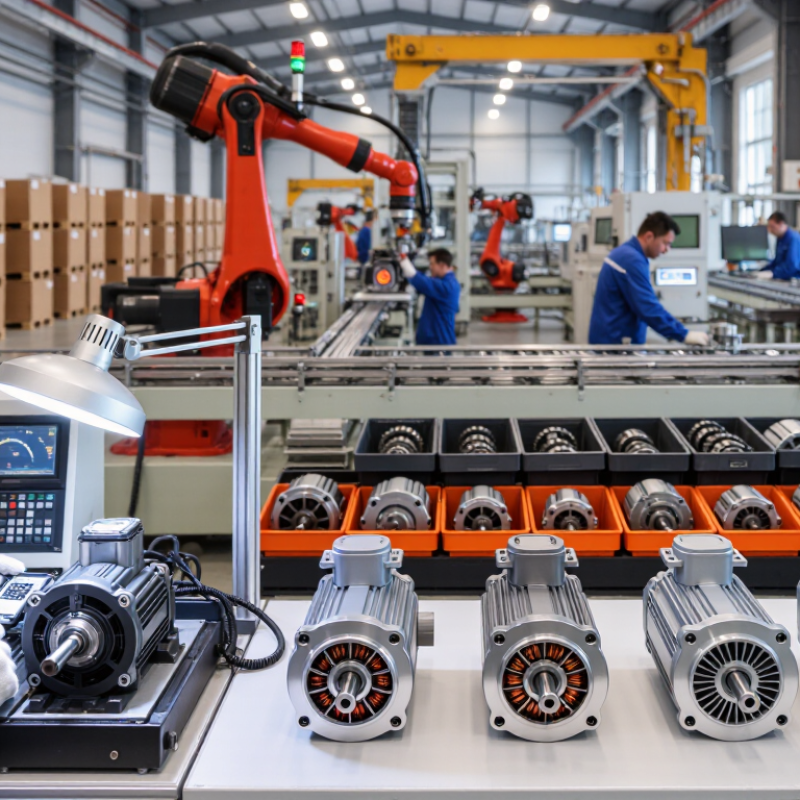
A 12V electric motor manufacturer in China is more than a workshop that assembles a motor and prints a voltage label. The term should describe a company able to control key steps: electromagnetic design, winding, rotor balancing, housing fit, and final testing. Ask how it checks current draw, starting torque, temperature rise, vibration, and noise under a defined load. Numbers matter. So does the test setup. A brief no-load spin cannot show how a motor performs in a compact pump, seat adjuster, or small actuator after repeated starts.
Manufacturing depth also shows in traceability and process consistency. Can the supplier link a batch of copper wire, magnets, and bearings to a production record? Does it keep samples from routine runs and explain what happens when a result falls outside tolerance? These are practical questions, not paperwork for its own sake. Request drawings, test conditions, and a sample evaluated in the intended assembly; a 12V rating alone says little about fit or service life. Be cautious with broad claims such as “custom” or “high efficiency” unless they are tied to measurable conditions. Even a capable factory can miss a detail. A connector may face the wrong way, or a shaft may be a fraction too long. Checking early saves trouble later.
A 12V motor is designed around a nominal supply voltage. The reference values below show typical voltages for a six-cell lead-acid battery; they are not a manufacturer ranking or motor performance measurements.
When evaluating a motor manufacturer, request datasheet values for operating-voltage range, current, speed, torque, duty cycle, and test conditions. Battery voltage varies with charge, load, temperature, and battery condition, so confirm compatibility with the intended application.
Ranking China’s top 10 12V electric motor manufacturers requires more than comparing catalog prices. The China Association of Automobile Manufacturers reported 9.495 million new-energy vehicles sold in China in 2023. This growth increases demand for compact motors used in pumps, fans, actuators, and thermal systems.
Our ranking model gives 25% to verified production capacity and delivery consistency. Electrical performance receives 20%, including starting torque, current stability, noise, and service life. Quality control accounts for another 20%, based on traceable testing, failure analysis, and compliance with IEC 60034 principles. Custom engineering, after-sales support, and environmental controls complete the score.
Testing matters on the factory floor.
A reliable supplier should provide endurance data, winding-temperature records, and samples from actual production batches. The IEA’s Global EV Outlook 2024 recorded nearly 14 million electric-car sales worldwide in 2023, with China representing the largest market. That figure supports strong manufacturing capability, but it does not prove every motor supplier is dependable. Some published claims remain difficult to verify. Our selection therefore favors audited evidence over attractive brochures, while recognizing that delivery performance can change during peak seasons.
Profiles of China’s top 10 12V electric motor manufacturers are most useful when they show more than catalog breadth. A buyer should compare motor type, rated speed, torque range, duty cycle, and mounting dimensions. Some manufacturers focus on compact motors for seat adjustment or small pumps; others support higher-load applications such as cooling fans and material handling. These distinctions matter. A 12V rating alone says little about performance under real load.
A reliable profile also describes how the manufacturer handles customization, sample testing, and production consistency. Look for clear drawings, stated operating limits, and test records that match the intended application. Ask how winding choices, shaft tolerances, or gearbox options affect delivery time. Small details matter. Public product information can help narrow choices, but it cannot replace a practical sample test.
The ten profiles should be compared using the same questions, not polished claims alone. Check whether technical answers are specific and whether available documentation supports them. Some suppliers may offer broad product ranges, while others provide deeper engineering support for a narrower field. Neither approach is automatically better. A weakness in many supplier profiles is limited detail about noise, heat, or performance after extended use; buyers should request evidence before making a decision.
China’s top 10 12V electric motor manufacturers should be assessed beyond production volume. Motor systems consume about 50% of global electricity, according to the International Energy Agency’s Energy Efficiency 2017 report. Even small 12V motors therefore need efficient windings, balanced rotors, and controlled heat generation. Factory experience matters. Engineers should inspect automated winding lines, end-of-line testing, and traceable component storage.
Quality evidence must be measurable. ISO 9001 certification supports process control, but it does not guarantee motor performance. Buyers should request torque curves, stall-current results, noise data, and endurance records. Automotive applications may also require IATF 16949-based controls and testing aligned with IEC 60034-1. The ISO Survey 2022 recorded more than 1.2 million ISO 9001 certificates worldwide, showing broad adoption, not equal reliability. Numbers can mislead.
Customization separates capable suppliers from simple assemblers. A strong manufacturer can adjust shaft length, connector position, gear ratio, sealing level, and mounting holes without weakening production consistency. Prototype samples should face vibration, humidity, reverse-polarity, and repeated start-stop tests. According to the IEA’s Global EV Outlook 2024, global electric car sales approached 14 million in 2023, increasing demand for compact auxiliary motors. Yet a clean showroom proves little. Some suppliers still provide incomplete lifetime data, and buyers must challenge those gaps. That extra scrutiny is often uncomfortable, but necessary.
This table provides an industry-level comparison of common 12V motor product categories and relevant manufacturing and verification criteria. It does not rank or identify individual manufacturers; capabilities vary by factory and should be confirmed through technical documentation and sample testing.
| Product Category | Common 12V Motor Configuration | Typical Applications | Manufacturing Capabilities to Assess | Relevant Quality Checks | Common Customization Options |
|---|---|---|---|---|---|
| Brushed DC motors | Permanent-magnet DC motor; brushed commutation | Small pumps, appliances, vehicle accessories, and general-purpose drives | Winding, rotor balancing, commutator assembly, brush installation, and end-of-line testing | Voltage, current, speed, torque, noise, and temperature-rise checks; applicable rotating-machine requirements include IEC 60034-1 | Shaft dimensions, mounting pattern, lead wires, connectors, winding, and suppression components |
| 12V gearmotors | Brushed DC motor combined with spur, planetary, or worm reduction | Actuators, small mechanisms, access-control equipment, and powered adjustments | Gear cutting or sourcing, gearbox assembly, lubrication, backlash control, and motor-gear matching | No-load and loaded speed, output torque, gear noise, backlash, and endurance under specified duty cycles | Gear ratio, output shaft, gearbox orientation, mounting features, limit switches, and connector type |
| BLDC motors | Three-phase brushless permanent-magnet motor, typically requiring an electronic controller | Fans, pumps, compact traction systems, and other applications requiring electronic speed control | Stator winding, rotor magnet assembly, balancing, sensor integration, and controller compatibility checks | Phase resistance, back-EMF, insulation, vibration, speed, and operation with the specified controller | Hall sensors or sensorless operation, winding design, shaft, connector, controller parameters, and mounting |
| Automotive actuator motors | Compact brushed DC motor, often supplied with a reduction gearbox | Seat, mirror, window, locking, and other low-voltage vehicle mechanisms | Repeatable assembly, traceability, process controls, and validation against the vehicle program’s requirements | Electrical and mechanical function, operating temperature, vibration, durability, and customer-defined validation tests | Gear train, output interface, wiring harness, connector, noise targets, and application-specific mounting |
| 12V fan motors | Brushed DC or BLDC motor matched to an axial or centrifugal fan | Electronics cooling, ventilation, compact equipment, and vehicle thermal management | Motor and impeller matching, rotor balancing, airflow assembly, and acoustic inspection | Speed, current, airflow or pressure as specified, noise, vibration, and thermal performance | Fan diameter, blade geometry, airflow direction, speed control, connector, and protection features |
| 12V pump motors | Brushed DC or BLDC motor coupled to a pump head | Water circulation, fluid transfer, washer systems, and small dispensing equipment | Motor-pump integration, sealing assembly, material control, and leak-test procedures | Flow and pressure at stated test conditions, current draw, leakage, noise, and endurance | Wetted materials, inlet and outlet geometry, cable length, connector, and operating curve |
| Automotive starter motors | High-current brushed DC motor designed for short-duration cranking duty | Starting combustion engines in vehicles and equipment designed for 12V electrical systems | Heavy-current winding and connection processes, solenoid integration, and robust mechanical assembly | Cranking performance under defined voltage and load, current draw, engagement function, and durability testing | Mounting flange, pinion configuration, rotation direction, terminal layout, and application-specific fit |
| Linear actuator motors | 12V DC motor driving a lead screw or geared linear mechanism | Adjustable furniture, access systems, medical equipment, and industrial positioning | Motor-drive integration, screw assembly, end-stop design, and force or travel testing | Travel, speed, force, holding behavior, current, limit-switch operation, and cycle life | Stroke length, load rating, speed, mounting brackets, limit switches, and control wiring |
| 12V stepper motors | Multi-phase motor operated by a compatible stepper driver; supply voltage depends on the system design | Positioning mechanisms, instruments, and equipment requiring controlled incremental motion | Stator winding, rotor assembly, lead identification, and motor-driver pairing validation | Winding resistance and inductance, step accuracy, torque-speed behavior, and temperature rise | Step angle, winding configuration, shaft, connector, cable, and holding-torque requirements |
| Custom 12V motor assemblies | Motor integrated with a gearbox, fan, pump, actuator, or application-specific mechanism | Specialized equipment and products with defined space, load, or control requirements | Design-for-manufacturing review, prototype builds, tooling control, assembly validation, and production testing | Acceptance criteria defined by the product specification; IP classification can be assessed using IEC 60529 where applicable | Mechanical interfaces, electrical connections, winding, control method, enclosure, and test limits |
China’s 12V motor manufacturers serve varied needs, from vehicle accessories to home appliances and compact automation. A window lifter needs reliable starting torque and frequent reversals. A small pump may need steady operation, moisture protection, and low noise. The application shapes the right motor more than a simple ranking does.
Manufacturers can differ in winding design, gear reduction, shaft dimensions, sealing, and quality testing. These choices affect speed, torque, heat, service life, and fit. Compare the rated voltage, continuous torque, no-load current, stall current, and duty cycle. Ask how each figure was measured. Some product sheets emphasize peak torque, which may not reflect everyday performance. That comparison is not always tidy.
Tips: Test a sample under the real load, using the intended wiring and mounting points. Check temperature after repeated starts, not just during a brief bench test. A quiet motor may still run hot. Confirm dimensions and connector details before ordering; small mismatches can mean costly rework.