What is the Various Types Of DC Motors Explained?
Electric motors play a vital role in our daily lives. Among them, the Various Types Of DC Motors are essential for many applications. These motors convert electrical energy into mechanical energy effectively. They are widely used in toys, appliances, and industrial equipment.
Understanding the characteristics of different DC motors can enhance performance in specific tasks. Each type has unique features, advantages, and limitations. For instance, brushed DC motors are simple but may wear out faster. Brushless variants offer greater efficiency but require more complex controls.
Choosing the right motor is sometimes a challenge. It's important to consider factors like load, speed, and efficiency. Reflecting on these aspects can prevent costly mistakes. Knowing the Various Types Of DC Motors available can lead to better decisions and improved designs.
Types of DC Motors: An Overview of Different Classifications
DC motors are widely classified into different types based on their design and operational characteristics. The primary classifications include brushed, brushless, series, parallel, and compound motors. Brushed DC motors are the most common type, utilizing brushes to provide electrical contact. They are simple, cost-effective, and suitable for a variety of applications. However, they can suffer from wear and require maintenance over time.
Brushless DC motors, on the other hand, offer a longer lifespan and higher efficiency. They are increasingly popular in industries where precision and durability are essential. According to industry reports, the global brushless DC motor market is projected to grow at a substantial rate, driven by advancements in technology and a shift towards automation.
Tips: Pay attention to the cooling requirements of each motor type. Poor heat dissipation can significantly reduce performance and lifespan. Understanding load requirements is also crucial; not all motors can handle the same amount of torque or speed. Always consider the specific application. If unsure, consult with an expert to avoid costly mistakes.
Brushed DC Motors: Principles, Construction, and Applications
Brushed DC motors have been a staple in various industries for decades. Their simple design features a stator, rotor, and brushes that facilitate current flow. The brushes make contact with the commutator, enabling the motor to turn. This straightforward mechanism is one reason why brushed motors are popular.
Applications for these motors are vast. They are found in toys, appliances, and automotive systems. According to a recent market analysis, the global brushed DC motor market is expected to reach $8.3 billion by 2025. Their ease of control and startup are significant advantages, making them ideal for low-speed applications. However, the wear and tear on brushes can lead to maintenance issues, which is a drawback many manufacturers face.
While brushed motors remain prevalent, they are not without their challenges. The limited lifespan of brushes can cause reliability concerns. Noise and electromagnetic interference also arise from their operation. Alternative solutions, such as brushless DC motors, are gaining traction as technology advances. But affordability often keeps brushed motors in the spotlight. Balancing performance and longevity is crucial for designers today.
What is the Various Types Of DC Motors Explained? - Brushed DC Motors: Principles, Construction, and Applications
| Type of DC Motor |
Principle |
Construction |
Applications |
| Brushed DC Motor |
Uses direct current to produce rotary motion. |
Contains brushes, a commutator, rotor, and stator. |
Used in toys, household appliances, automotive applications. |
| Brushless DC Motor |
Operates without brushes, using electronic controllers instead. |
Constructed with magnets and electronic commutation. |
Common in computer cooling fans and electric vehicles. |
| Permanent Magnet DC Motor |
Utilizes permanent magnets to generate the magnetic field. |
Simpler construction due to permanent magnets. |
Widely used in small electric vehicles and robotics. |
| Series DC Motor |
Field windings connected in series with the armature. |
Features high starting torque. |
Used in cranes and electric traction systems. |
| Shunt DC Motor |
Field windings connected in parallel with the armature. |
Provides stable speed under varying loads. |
Used in lathes and manufacturing equipment. |
Brushless DC Motors: How They Operate and Their Advantages
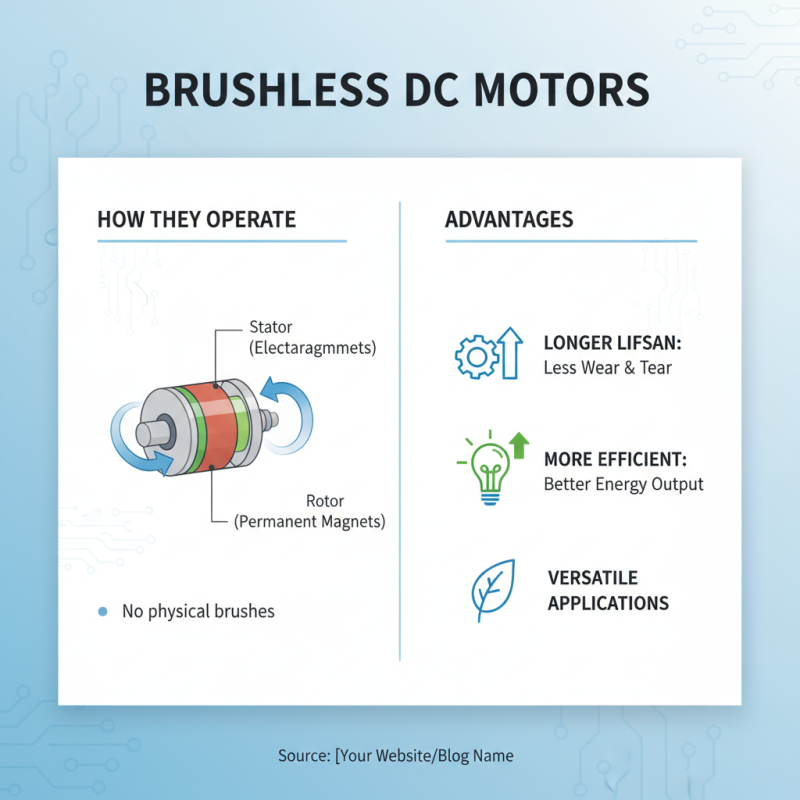
Brushless DC motors are gaining popularity for various applications. They differ from traditional brushed motors by eliminating the need for brushes. This design results in less wear and tear, which leads to longer life. Additionally, brushless motors operate more efficiently, providing better energy output.
The operation of brushless DC motors relies on electronic controllers. These controllers manage the phase of the motor’s stator windings. This means they can adjust the motor's speed and torque easily. As a result, these motors deliver precise control over performance. Whether in drones, electric vehicles, or industrial machines, brushless designs offer advantages.
Though brushless motors have many benefits, they are not without drawbacks. The initial cost can be higher than brushed variants. Additionally, the complexity of electronic controllers can pose challenges in certain applications. Not everyone may find it easy to work with this technology. These factors might deter some users, who might be more comfortable with simpler systems.
Permanent Magnet vs. Series Wound DC Motors: Key Differences and Uses
Permanent magnet and series wound DC motors have distinct characteristics and applications.
Permanent magnet DC motors utilize magnets for generating a magnetic field. This design makes them compact and lightweight.
They are effective for applications needing steady torque and speed. However, they can be limited by temperature changes affecting the magnets.
On the other hand, series wound DC motors have their field windings connected in series with the armature.
This configuration allows for high starting torque.
They are ideal for applications like electric vehicles and cranes. However, they may face challenges with speed control and can be less efficient at higher speeds.
Both types have unique advantages and limitations.
Understanding these differences is crucial when selecting the right motor for specific tasks.
Consider the application requirements and usability.
This will ensure optimal performance and longevity.