Top Motor Types Explained What Are the Different Types of Motors?
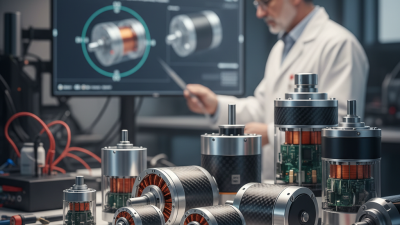
When it comes to machinery and technology, understanding motor and types is essential. Motors play a critical role in countless applications. From small gadgets to large industrial machines, each motor type serves a unique purpose.
Different motor types vary in design, functionality, and efficiency. Electric motors are common, but their complexity can confuse many. Some electric motors convert electrical energy into mechanical energy efficiently, while others struggle with performance. Internal combustion engines are another category. They power vehicles but can be less efficient than electric alternatives.
Choosing the right motor is not always clear-cut. It's easy to overlook specific needs and applications. This decision impacts efficiency and output significantly. Reflecting on these differences helps in making informed choices. Each motor type has strengths and weaknesses that require thoughtful consideration. Understanding the landscape of motor and types will enhance your knowledge and decisions in technology.
Types of Electric Motors: A Comprehensive Overview
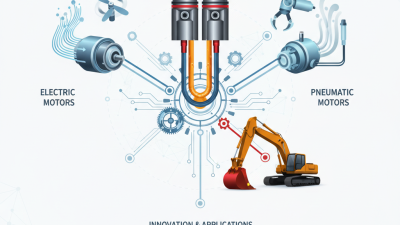
Electric motors are ubiquitous in modern technology. They power everything, from household appliances to industrial machines. Understanding the different types of electric motors is crucial for selecting the right one for a specific application.
There are several common types of electric motors. Induction motors are popular due to their durability and simplicity. They operate without needing brushes and are often used in fans and pumps. However, they can struggle with speed control. Synchronous motors, on the other hand, excel in precision applications. They maintain a constant speed, but they can be more complex to operate.
Another type is the stepper motor, often found in 3D printers and robotic arms. These motors move in fixed steps, allowing for precise positioning. But they may lack torque at high speeds. Understanding these motors' strengths and weaknesses helps industries optimize performance. This knowledge leads to better machine efficiency and longevity, which is vital in today's competitive landscape.
Top Motor Types Explained
This chart provides an overview of the different types of electric motors and their applications. Each motor type is represented by the power output range in kilowatts (kW).
Understanding DC Motors: Characteristics and Applications
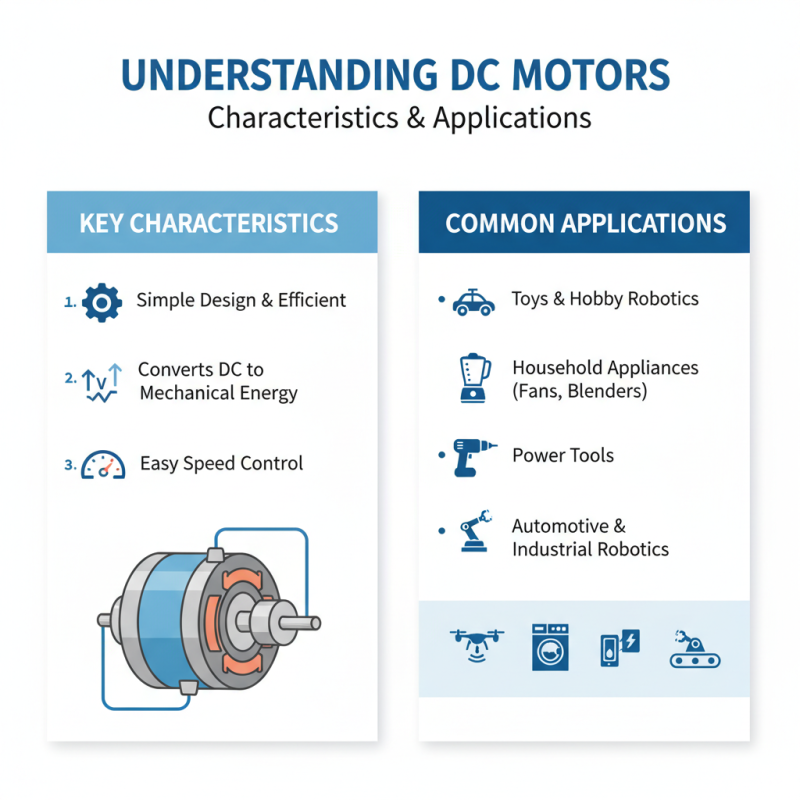
DC motors are a popular choice in various applications due to their simplicity and efficiency. These motors convert direct current electrical energy into mechanical energy. They are widely used in small devices like toys, household appliances, and even larger machinery. The speed of a DC motor can be easily controlled, making it versatile in different settings.
The primary characteristic of DC motors is the presence of a commutator. This component helps in reversing the direction of current flow. Additionally, DC motors can be classified into brushed and brushless types. Brushed motors are simpler but can wear out faster. Brushless motors have a longer lifespan and are more efficient.
However, they also come with higher costs. Understanding the limitations and advantages is crucial. It’s essential to consider factors like load requirements and speed control when selecting a motor. Each application may highlight different needs. Thus, one must reflect on specific conditions that will affect the motor's performance.
Exploring AC Motors: Types and Their Functionalities
AC motors are widely used in various applications, ranging from household appliances to large industrial machinery. These motors can be classified mainly into two types: synchronous and asynchronous. Synchronous motors run at constant speed, directly linked to the power supply frequency. They are often used in applications requiring precise speed control. On the other hand, asynchronous motors, or induction motors, are more common. They are simpler in design and capable of handling a wide range of loads. According to industry reports, about 75% of all electric motors used globally are induction motors.
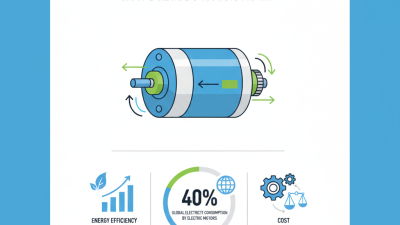
In terms of efficiency, recent studies indicate that improving AC motor designs could save billions in energy costs. For example, using high-efficiency motors can reduce energy consumption by 3% to 8%. While this may seem modest, in large industrial settings, these savings accumulate significantly. However, many facilities still rely on older models that do not comply with new efficiency standards. This raises questions about their long-term operational costs and environmental impact.
Understanding the functionalities of AC motors is crucial for optimizing performance. Many operators overlook the importance of regular maintenance and monitoring. Failing to do so can lead to unplanned downtime, impacting productivity. Moreover, the choice between synchronous and asynchronous motors should align with the specific needs of the application and load requirements. Investing time in this evaluation can drive improved efficiency and reduce operational risks.
Top Motor Types Explained: What Are the Different Types of Motors?
| Motor Type |
Power Source |
Efficiency |
Applications |
| AC Motors |
Alternating Current |
High |
Industrial machines, Fans, Pumps |
| DC Motors |
Direct Current |
Moderate |
Electric vehicles, Robotics, Toys |
| Servo Motors |
AC or DC |
Very High |
Automation, CNC machinery, Robotics |
| Stepper Motors |
DC |
High |
3D printers, CNC machines, Robotics |
Introduction to Stepper Motors: Precision and Control
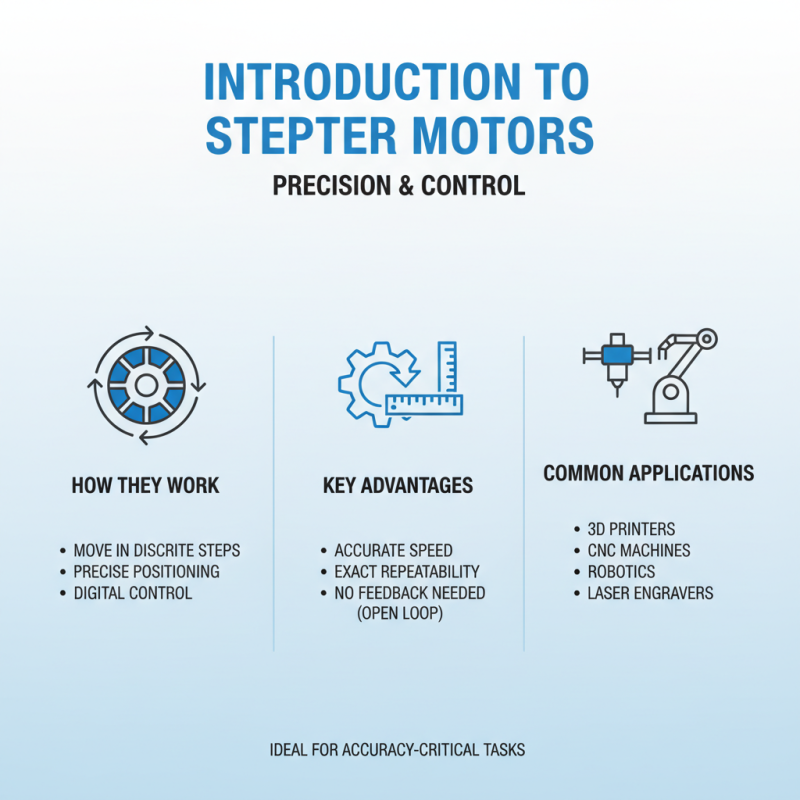
Stepper motors are unique in their ability to offer precise control over positioning and speed. They move in discrete steps, making them ideal for applications that require accuracy. This feature allows users to control each step with great precision, unlike traditional motors that operate continuously. These motors are commonly used in 3D printers, CNC machines, and robotics, where detailed movement is critical.
The mechanics of stepper motors involve multiple coils and winding arrangements. When energized in a specific sequence, they create magnetic fields that rotate the motor shaft in defined increments. This design makes them both powerful and easy to control. However, the level of control can sometimes lead to challenges. If the input signal isn’t timed correctly, the motor may skip steps. This can result in inaccuracies.
One common issue is resonance. At certain speeds, stepper motors may vibrate excessively. This can affect the precision of the task at hand. Users often need to address these flaws to improve performance. Despite their challenges, stepper motors remain vital in applications where precision and control are paramount. Understanding their intricacies can lead to better designs and solutions.
A Look at Servo Motors: How They Provide Accuracy in Movement
Servo motors are essential for applications requiring precise control over movement. They use feedback mechanisms to ensure accuracy. According to the International Society of Automation, servo motors can achieve position accuracy to within ±0.1 degrees. This precision makes them ideal for robotics and CNC machines.
Their operation involves both a motor and a control system. The control system processes signals to adjust the motor's position. Reports indicate a growing demand for servo motors in industrial automation. The market is expected to reach $11.5 billion by 2027, driven by these applications.
However, using servo motors isn't without challenges. They require complex control algorithms and can be expensive. Engineers must consider the trade-off between precision and cost-effectiveness. Balancing these factors can be tricky. Many professionals still seek improvements in reliability and performance. Overall, servo motors play a vital role in industries aiming for high precision in motion.