How to Choose the Right Motor Controller for Your Project?
Selecting the right motor controller can be a daunting task. Every project has unique needs. Motor controllers vary widely in types and specifications. They impact performance, efficiency, and cost. It's crucial to understand your application’s requirements. Will it be a robotic arm or a simple fan? Each scenario demands a different approach.
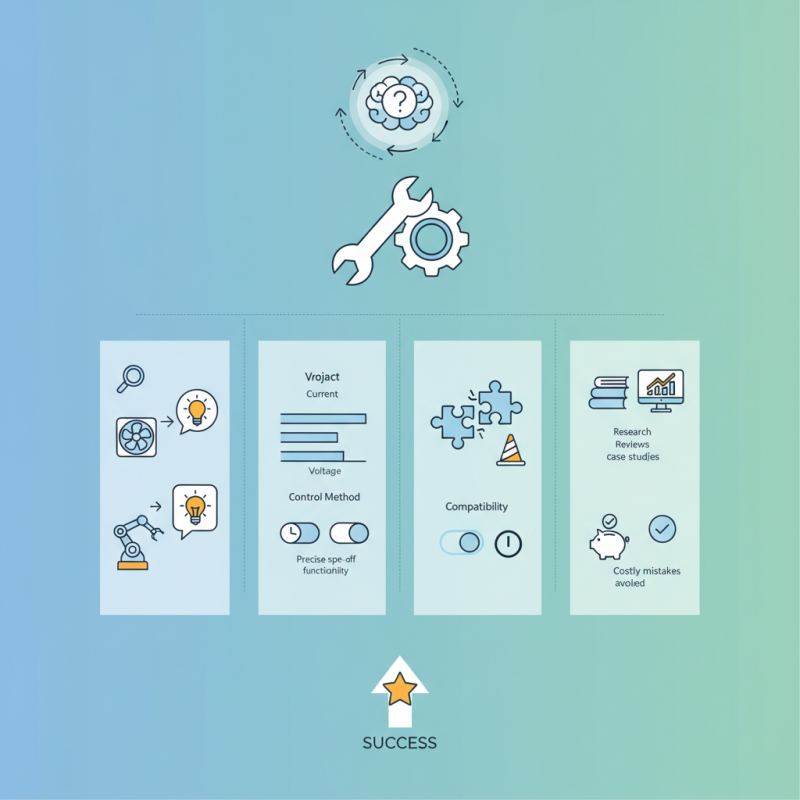
Consider factors like voltage, current ratings, and control methods. Do you need precise speed control? Or basic on-off functionality? Evaluating these details helps narrow your choices. Also, keep in mind that integrating a motor controller isn't always straightforward. Compatibility with other components can be tricky. This can lead to unexpected challenges during implementation.
Take the time to research various motor controller options. Check user reviews and case studies. Learning from others' experiences can guide your decision. Don't rush this important choice. Finding the right motor controller is vital for your project's success. It can make all the difference. A thoughtful approach can help you avoid costly mistakes. So, ponder over your needs.
Understanding the Basics of Motor Controllers and Their Functions
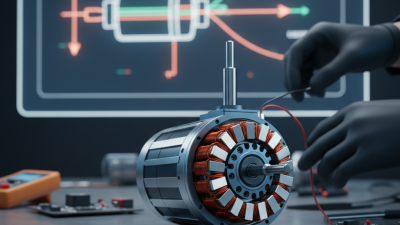
Motor controllers are essential for managing the operation of electric motors. They regulate speed, direction, and torque, ensuring that motors perform efficiently. Understanding their functions helps you choose the right one for your project. There are various types of motor controllers, including brushed and brushless models. Each type has specific applications, which can affect your project’s performance.
When selecting a motor controller, consider the voltage and current ratings. Ensure the controller matches your motor's specifications. Inadequate ratings can lead to overheating or failure. Keep your project goals in mind. If you need precise control, look for controllers with PWM (Pulse Width Modulation) features. These options provide smoother operation.
**Tips:** Pay attention to the environment where the motor will operate. Dust and moisture can impact performance. It’s crucial to choose a controller with proper protection ratings. Also, think about heat dissipation. A controller that runs too hot might need extra cooling. Testing various controllers can help you find the best fit for your needs. Remember, there is no one-size-fits-all solution, and learning from trial and error is valuable.
Comparative Analysis of Motor Controller Types
Identifying the Requirements of Your Specific Project
Choosing the right motor controller is crucial for project success. Start by evaluating your specific needs. Understand the type of motor you'll use. For example, DC motors, stepper motors, and servo motors have different control requirements. A report by the International Electrotechnical Commission indicates that proper motor selection can increase efficiency by up to 30%.
Next, assess the operational environment. Will the controller face extreme temperatures or humidity? This impacts durability and efficiency. A study from the IEEE shows that 25% of project failures are linked to inadequate environmental considerations. Additionally, determine your power supply limitations. Different controllers require varying voltages and currents.
In terms of complexity, some projects may benefit from advanced features like regenerative braking or feedback control. However, adding complexity can lead to user errors and increase costs. Balancing functionality with simplicity is vital. Data shows that about 15% of users later wish they had chosen simpler options. Consider these factors carefully, as they significantly shape the performance and longevity of your project.
Evaluating Different Types of Motor Controllers Available
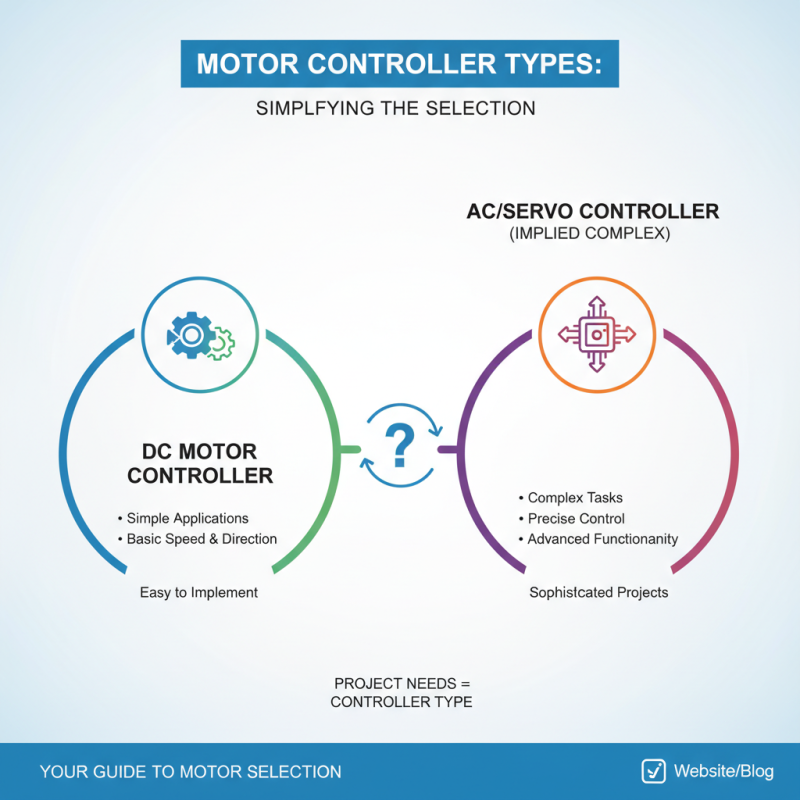
When choosing a motor controller, it's essential to evaluate the available types. Different projects require specific functionalities. For example, a DC motor controller is suitable for simple applications. These are easy to implement and understand. They provide basic speed and direction control. Their simplicity can sometimes lead to limitations, making them less suitable for complex tasks.
Another option is the stepper motor controller. These controllers are ideal for precision movement. They allow for precise positioning in applications like robotics. However, they often require more complex programming and setup. Users can find themselves frustrated with their complexity. It's crucial to balance the need for precision against the ease of use.
Lastly, consider brushless DC motor controllers. These offer higher efficiency and longer life. They are great for applications demanding high performance. Yet, they come with a learning curve that can be intimidating. Not every project benefits from their capabilities. Weighing all these factors will help in making a more informed decision for your project.
Analyzing Compatibility with Motors and Power Sources
Choosing the right motor controller is crucial for your project’s success. Compatibility with both motors and power sources plays a vital role. It can affect performance, efficiency, and overall reliability. Ensure you check specifications of your motor. Understand voltage and current requirements before making a decision.
When analyzing compatibility, look for specifications that match your motor. For example, a controller should handle the maximum current drawn by the motor. If these values do not align, your project may face malfunctions or inefficient operation. Pay attention to the type of connection as well.
**Tips:** Always double-check the ratings. A mismatch can lead to overheating. Also, consider future needs. You might want to upgrade later. Keep in mind that an underpowered controller could limit your project's potential. A common pitfall is overlooking these aspects, leading to unnecessary frustration. Be cautious about assumptions. Every detail matters in motor control systems.
How to Choose the Right Motor Controller for Your Project?
| Motor Type |
Power Source |
Voltage (V) |
Current Rating (A) |
Controller Compatibility |
| DC Brush Motor |
Battery |
12 |
10 |
Yes |
| Stepper Motor |
AC Power Supply |
24 |
2 |
Yes |
| Brushless DC Motor |
Battery |
36 |
15 |
Yes |
| Servo Motor |
AC Power Supply |
48 |
5 |
Yes |
Considering Additional Features for Enhanced Control and Performance
Choosing the right motor controller involves more than basic functionality. It requires consideration of additional features that can elevate performance. For instance, advanced control algorithms can significantly enhance responsiveness. A recent study shows that integrating intelligent algorithms can improve system efficiency by 20%. This is a game-changer for projects that demand precision.
Temperature management is another critical feature. Overheating can lead to failure, affecting your project’s reliability. Controllers with built-in thermal protection extend the lifespan of motors. Without this, you risk costly downtimes. Data from industry reports indicates that effective thermal management can reduce failure rates by up to 30%. This statistic emphasizes the importance of factoring heat dissipation abilities into your selection.
User interface accessibility shouldn't be overlooked. A complex setup can lead to frustration and mistakes. Controllers that offer user-friendly software tools enable smoother operations. Interestingly, data suggests that 75% of engineers found ease of use critical in their productivity. Choosing a controller with intuitive features can save time and enhance project outcomes. Despite these insights, engineers must continually reassess their needs as projects evolve.