China Best DC Motors With Encoders for Enhanced Performance and Precision?
In the fast-evolving landscape of automation and robotics, the significance of DC motors with encoders cannot be overstated. These motors combine precision control with robust performance, making them essential for various applications. Chinese manufacturers are at the forefront, offering a wide range of options that cater to diverse industrial needs.
DC motors with encoders facilitate real-time feedback, enabling accurate positional and speed control. This accuracy is critical in fields such as robotics, CNC machinery, and automated systems. However, choosing the right motor requires careful consideration. Not all products meet the same standards of durability and reliability. It’s essential to assess the specifications and performance metrics critically.
While many products promise superior performance, not all deliver. Users must sift through marketing claims to find authentic reviews and expert insights. Researching reputable manufacturers in China can reveal trustworthy options. In this quest for the best, consumer experiences play a crucial role. You may find variability among motors, prompting further evaluation. Understanding these nuances will enhance decision-making and ultimately lead to better results in your projects.
China's Leading DC Motors with Encoders: Overview of the Market Landscape
The market for DC motors with encoders in China is growing rapidly. Manufacturers are focusing on high-quality products to meet diverse industrial needs. These motors are essential for applications requiring precision control and performance. Industries like robotics, automation, and automotive are key players in this market.
One notable trend is the increasing demand for customized solutions. Buyers seek motors tailored to specific applications. The integration of encoders enhances feedback capabilities. This allows for accurate position and speed control. However, many manufacturers still struggle with quality consistency. Ensuring robust performance across varying conditions is crucial yet challenging.
Additionally, the supply chain has faced recent disruptions. This has led to concerns about availability and pricing stability. Engineers need to be cautious when selecting suppliers. The emphasis on research and development is vital to maintaining competitiveness. Hence, potential buyers should seek manufacturers with proven expertise and reliability in the field.
Key Applications of DC Motors with Encoders in Various Industries
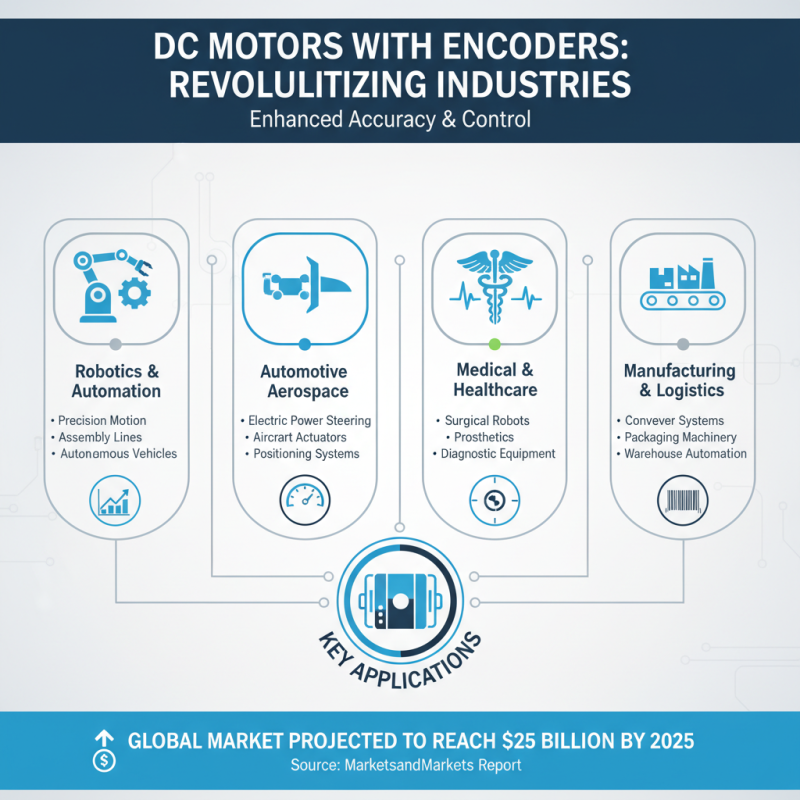
DC motors with encoders are revolutionizing numerous industries. They provide enhanced accuracy in applications such as robotics and automation. According to a report by MarketsandMarkets, the global market for motion control systems, including these motors, is projected to reach $25 billion by 2025. Many sectors, from automotive to aerospace, benefit from this technology.
In robotics, these motors ensure precise movements, crucial for tasks like assembly and material handling. Data from the Robotic Industries Association shows that industrial robot sales hit a record high. The demand for precision from DC motors with encoders supports this growth. However, manufacturers sometimes face challenges integrating these systems. Ensuring reliability can be difficult, particularly in harsh environments.
Another key application is in medical devices. These motors drive equipment like surgical robots, where accuracy is vital. A study published in the Journal of Medical Robotics indicates that robotic surgeries reduce patient recovery time by 30%. Engineers must continuously innovate to improve efficiency, addressing limitations in current technologies. Proper testing and validation are essential to mitigate risks associated with failures.
Technical Specifications That Define High-Performance DC Motors
When discussing high-performance DC motors with encoders, technical specifications play a crucial role. Key aspects include torque, speed range, and power output. A motor's torque determines its ability to start and sustain loads effectively. Speed range affects how fast the motor can operate under different conditions.
Another essential factor is the encoder type. Incremental encoders provide relative position feedback, while absolute encoders deliver precise location data at any given moment. This distinction can impact the overall performance and accuracy of applications. Understanding these technical details allows for better selections tailored to specific needs.
Tips for selecting DC motors with encoders: Ensure you assess application requirements clearly. Look for motors that offer a balance of speed and torque. Additionally, consider the environment where the motor will operate. Factors like temperature, vibration, and dust can influence performance. Fine-tuning your choice based on these conditions can lead to significant improvements.
China Best DC Motors With Encoders for Enhanced Performance and Precision
| Motor Model |
Rated Voltage (V) |
Rated Power (W) |
Max Speed (RPM) |
Encoder Type |
Feedback Resolution (PPR) |
Torque Constant (Nm/A) |
| DCM-120 |
24 |
100 |
4000 |
Incremental |
500 |
0.3 |
| DCM-150 |
36 |
200 |
3000 |
Absolute |
1000 |
0.5 |
| DCM-200 |
48 |
250 |
6000 |
Incremental |
750 |
0.7 |
| DCM-250 |
12 |
50 |
2000 |
Absolute |
500 |
0.2 |
Case Studies: Enhanced Performance through Encoder Integration
The integration of encoders in DC motors significantly enhances their performance. Case studies reveal that motors equipped with encoders achieve improved accuracy and responsiveness. For instance, a recent industry report highlighted that systems using encoders increased productivity by up to 30% in manufacturing applications. This precision is particularly valuable in robotics and automation.
One noteworthy application involved a robotics manufacturer that enhanced its assembly line efficiency by integrating encoders. The encoder-driven motors reduced positional errors by 20%. This allowed for tighter tolerances in automated tasks. Yet, manufacturers should consider the complexity and cost that encoder integration may introduce. Balancing precision with budget constraints can be challenging.
**Tips:** Regular maintenance of encoders is crucial to sustaining their performance. Ensuring that connections are secure can prevent operational issues. Additionally, training staff on the correct use of these systems may mitigate misinterpretations of data. Proper implementation can lead to remarkable outcomes but requires ongoing evaluation.
DC Motors with Encoders Performance Comparison
Future Trends in DC Motor Technology and Precision Control Systems
The future of DC motor technology is rapidly evolving. One major trend is the integration of advanced encoders. These devices greatly enhance precision in motor control. According to industry reports, the demand for high-performance actuators in robotics and automation is expected to rise by 8% annually over the next five years. This growth affirms the need for refined control systems.
Moreover, the shift towards electric vehicles (EVs) has spurred innovation in DC motors. Encoders provide real-time feedback, improving efficiency and reducing energy consumption.
For instance, a 2022 analysis revealed that precision control systems could decrease energy wastage by up to 30%. This statistic highlights the importance of efficiency in future designs.
Despite these advancements, challenges remain. The complexity of smart feedback systems can lead to integration issues. Data from recent studies indicate that manufacturers are often unprepared for technical discrepancies. Addressing these shortcomings is crucial for successful implementation.
Enhancing the relationship between DC motors and encoders is necessary to meet growing industry demands.