How to Calculate Motor Torque for Optimal Performance?
Understanding how to calculate motor torque is crucial for achieving optimal performance. Motor torque determines how effectively a motor converts electrical energy into mechanical energy. It directly influences speed, acceleration, and overall efficiency.
When evaluating motor torque, consider factors such as load requirements, gear ratios, and power supply capabilities. These elements play a significant role in the performance of a motor. However, it is easy to overlook these factors, leading to inefficiencies. Sometimes, miscalculations occur due to changing conditions, which can impact results.
Additionally, not all motors are created equal. Different types have distinct torque characteristics. Being aware of these differences can prevent costly mistakes. Reflecting on past experiences can provide insights into improving calculations, ensuring better outcomes in future projects.
Understanding the Basics of Motor Torque in Electrical Engineering
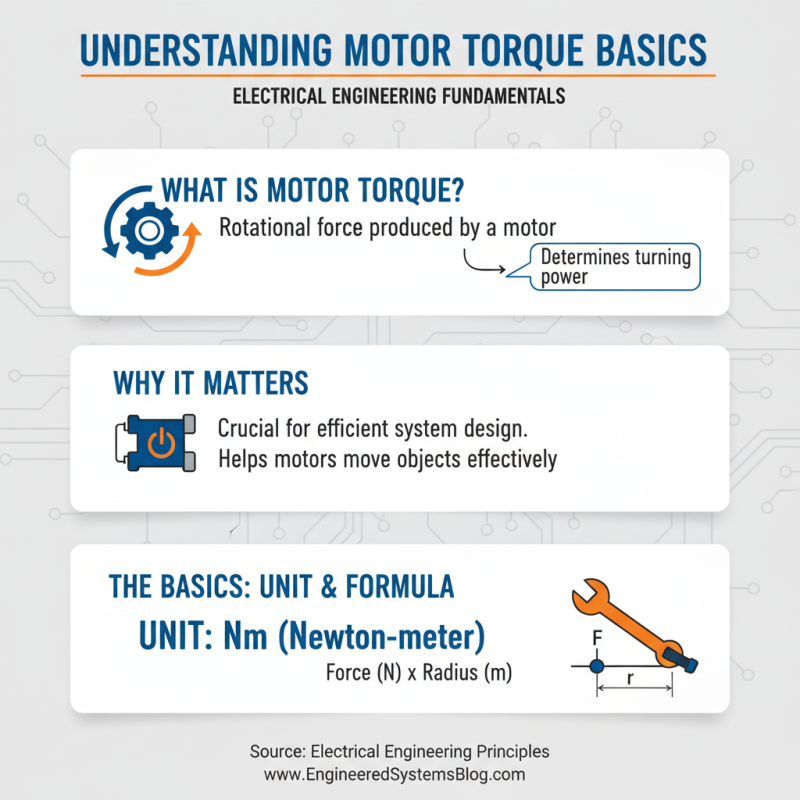
Motor torque is a crucial concept in electrical engineering. It determines how much rotational force a motor can produce. Understanding torque helps in designing efficient systems that use motors effectively. The basic unit of torque is Nm (Newton-meter). It tells us how much force can turn an object around an axis.
Calculating motor torque can be complex. One common method involves knowing the motor's power output and its speed. The formula is Torque = Power / Angular speed. This clearly shows the relationship between these elements. It's important to use correct units. Many engineers miscalculate due to unit confusion. A small error can lead to significant performance issues.
Friction and load are vital considerations too. A motor may perform well under ideal conditions but struggle in real applications. Adjustments often need to be made. For instance, adding lubrication can reduce friction, enhancing performance. Keeping these factors in mind can lead to better results. Engineers must take time to reflect on their calculations and scenarios. Mistakes in torque calculations can lead to unsuitable motor choices. This can impact efficiency, and the entire system.
Defining Torque: Key Concepts and Units in Motor Performance
Torque is a crucial factor in motor performance. It defines the rotational force an engine or motor can produce. Commonly measured in Newton-meters (Nm) or pound-feet (lb-ft), torque directly influences how effectively a motor can perform tasks. For instance, a motor producing 50 Nm of torque can generate significant power for applications like lifting or turning heavy objects.
Understanding the concept of torque helps in optimal motor selection. Research indicates that motors with higher torque ratings perform better under load, especially in industrial applications. An electric motor with a high torque-to-weight ratio is preferred in many sectors. This means it can deliver more power without being overly heavy, increasing efficiency.
Tip: When selecting a motor, always compare torque ratings against application requirements. Underestimating torque can lead to performance issues, resulting in delays or equipment failures. Ensuring the proper torque range can eliminate these risks.
Tip: Conduct regular torque checks during maintenance. This practice helps in identifying wear and potential performance drops early. Small changes in torque can indicate bigger underlying issues that need addressing.
Focusing on these key concepts contributes to better understanding and selecting the right motor for your needs.
Calculating Torque: Formulas and Factors Influencing Motor Efficiency
Calculating motor torque requires precise formulas and an understanding of various factors. The torque generated by a motor is fundamentally linked to its power output and speed. The basic formula is torque equals power divided by angular velocity. This simple equation is crucial for understanding how torque affects overall motor performance.
Several factors influence motor efficiency. The design, material, and operating conditions of the motor all contribute to its torque output. For instance, high-quality materials can reduce friction, while an optimized design improves airflow. Additionally, external factors like temperature and load impact torque production. If the motor's components are not well-matched, performance can suffer.
Many engineers wrestle with these calculations. It is easy to overlook how small adjustments can lead to significant changes in motor performance. Observing how variations affect torque can offer valuable insights. Mistakes in calculations or assumptions can lead to inefficient systems. Understanding the relationship between torque and efficiency is key to enhancing motor performance.
The Role of RPM and Power in Torque Calculation
When calculating motor torque, understanding the role of RPM and power is crucial. Torque is the force that causes rotations. It's calculated using the formula: Torque = Power / RPM. This means that power and RPM impact torque directly. If RPM increases, torque often decreases, provided power stays the same.
Power represents the engine's capacity to do work. RPM, or revolutions per minute, indicates how fast a motor turns. A motor needs to balance both for optimal performance. High RPMs might give speed but reduce torque. Conversely, low RPM can increase torque but may limit speed. Finding the sweet spot is key. It requires careful adjustment and testing to achieve.
Sometimes, a motor may not perform as expected. Issues like overheating or insufficient torque can arise. It's easy to overlook one of these factors. Regular assessment helps identify imbalances in power, RPM, or torque. Effective performance relies on these three elements working together. A little tweaking can lead to improved outcomes. Understanding their interrelation is vital.
Optimizing Torque: Best Practices for Different Motor Applications
When optimizing motor performance, understanding torque is crucial. Different applications require specific torque levels. For instance, in the automotive sector, a report from the International Energy Agency reveals that electric vehicles often require higher torque at lower speeds. This contrasts with traditional combustion engines that produce peak torque at higher RPMs. Such differences impact design choices dramatically.
In industrial applications, the right torque can enhance efficiency. A study by the National Institute of Standards and Technology shows that using optimal torque settings can improve motor lifespan by up to 40%. However, many engineers overlook this aspect. They might choose torque levels based on convenience rather than performance data. Failure to optimize can lead to energy wastage and increased wear on components.
It’s vital to tailor torque settings for specific tasks. For example, in robotics, precise torque control allows for delicate movements and reduces the risk of mechanical failures. However, achieving this precision isn't always straightforward. The complexity of motor systems can lead to miscalculations.
One must constantly reevaluate torque parameters. It’s not a one-time decision. As workloads change, torque settings should adapt. Companies often miss the opportunity to recalibrate their systems. They focus on immediate needs without considering long-term efficiency. Adjusting torque levels could significantly enhance performance over time.
How to Calculate Motor Torque for Optimal Performance?
| Motor Type |
Rated Power (HP) |
Rated Speed (RPM) |
Torque (lb-ft) |
Application |
| DC Motor |
2 |
1750 |
5.7 |
Conveyor Belt |
| AC Induction Motor |
5 |
3600 |
8.5 |
Pumps |
| Stepper Motor |
1.5 |
2000 |
3.1 |
3D Printers |
| Brushless DC Motor |
4 |
2500 |
6.2 |
Electric Vehicles |